In AR glasses the display is competing with the real world, and daylight is an opponent that does not negotiate. A 0.49-inch Micro OLED at 1920x1080 with 1800 nits of brightness and a 50,000:1 contrast ratio gives an optical designer a realistic starting point, but the panel specification is only the beginning of the calculation. The combiner, the ambient light reaching the eye through it, and the wearer's eye position all sit between that number and what the user actually perceives. This article separates the three optical variables that matter most in daylight, and shows which checks belong on the bench rather than in the datasheet.
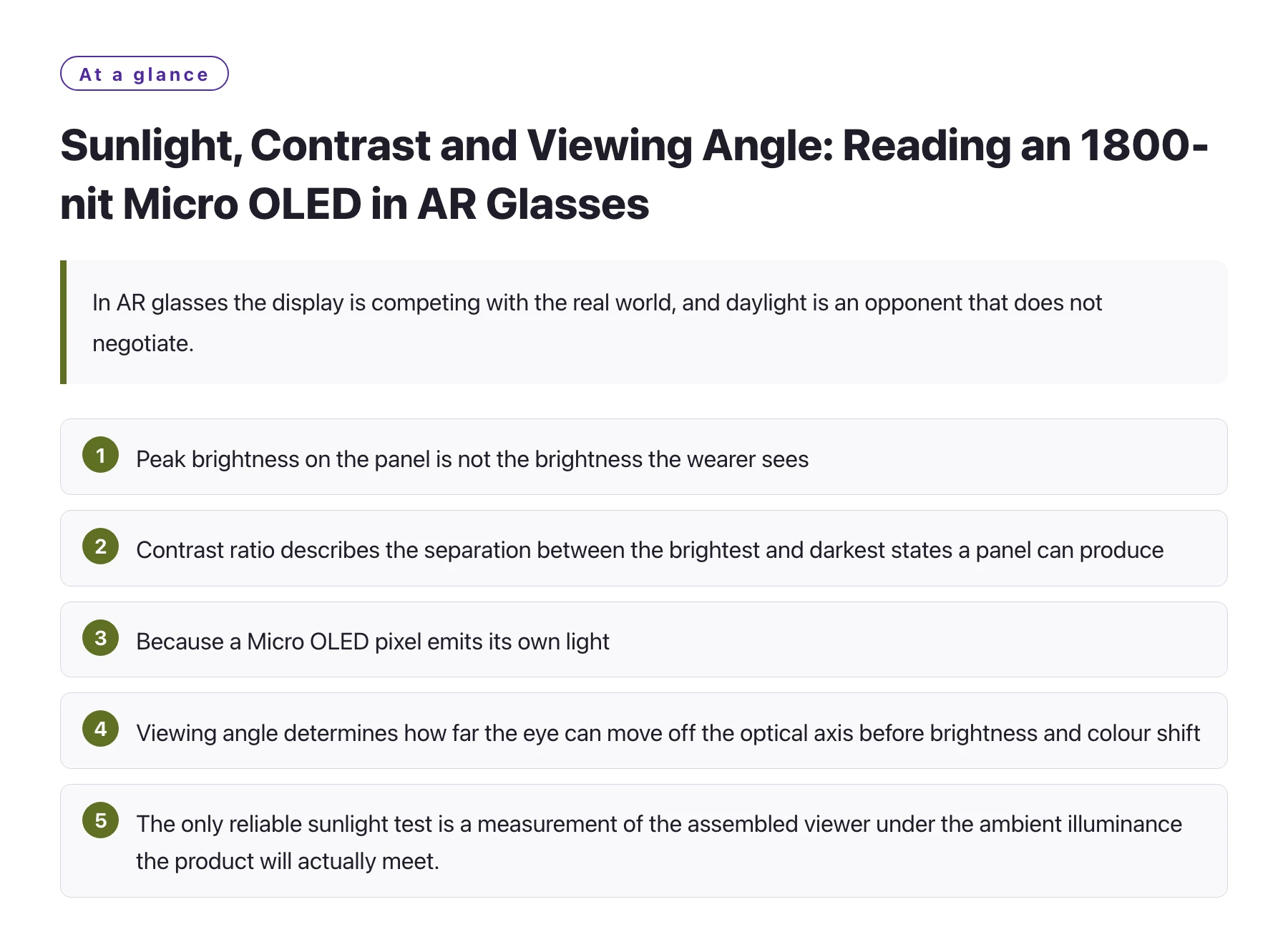
Key takeawaysPeak brightness on the panel is not the brightness the wearer sees, because the combiner and the optical path attenuate the image before it reaches the eye. · Contrast ratio describes the separation between the brightest and darkest states a panel can produce, and it is the variable that decides whether fine detail survives a bright background [1]. · Because a Micro OLED pixel emits its own light, dark areas stay genuinely dark instead of leaking light through a backlight, which is what makes high contrast possible in a near-eye system. · Viewing angle determines how far the eye can move off the optical axis before brightness and colour shift, and a wearable combiner has to be designed around that limit rather than against it. · The only reliable sunlight test is a measurement of the assembled viewer under the ambient illuminance the product will actually meet.
Augmented reality asks a display to do something no monitor has to do: put a convincing image on top of an uncontrolled background. On a desk, the display owns the whole field of view and the eye adapts to it. Outdoors, the eye is adapted to a scene thousands of times brighter than a typical indoor room, and the emissive image has to reach that adapted eye without flooding the see-through path.
A 0.49-inch Micro OLED module at 1920x1080 with 1800 nits and a 50,000:1 contrast ratio is a reasonable answer to that problem, but it only answers the first question. The image still has to pass through the combiner, survive the ambient light that reaches the eye through the same combiner, and remain stable as the wearer's pupil moves across the eye box.
The sections below deal with brightness in the assembled system, with contrast as the specification that governs detail, and with viewing angle as the constraint that decides how much eye movement the design can tolerate.
Why an emissive panel behaves differently outdoors
Contrast ratio is defined as the ratio between the brightest and darkest luminance a display can produce, and it is the parameter that most closely tracks perceived legibility [1]. A panel with high contrast keeps the difference between a bright wireframe annotation and the dark background it sits on, even when the eye is adapted to a bright scene. A panel with low contrast turns those thin annotations into a grey wash because the dark state is no longer dark.
The device physics behind that behaviour is well established: an organic light-emitting diode produces light when current passes through the emissive layer, so the pixel is its own light source and switches off completely in the dark state [3]. That is the structural reason a near-eye Micro OLED can hold detail in a way that a transmissive panel with a strong backlight struggles to match, because there is no light guide leaking around the shutter.
Brightness complements contrast rather than replacing it. Increasing panel brightness raises both the white state and, in a practical system, the amount of stray light the combiner scatters back toward the eye. Every additional nit has to earn its place by improving the ratio the user perceives, not merely by raising the top of it.
Contrast is the number that decides legibility
How a 50,000:1 ratio is specified
A contrast figure is only meaningful together with the conditions it was measured under: the drive level, the pattern used, the temperature and whether the measurement was taken at the panel or through the optics. Two suppliers can quote the same headline ratio and deliver noticeably different images behind an eyepiece. When a module is specified at 50,000:1, the useful follow-up question is how much of that survives in the assembled viewer.
For a near-eye product the practical metric is the contrast the wearer perceives against the real background, which means the number has to be re-measured after the combiner is in place. A bench measurement of the bare panel is a starting condition, not a result.
What contrast looks like through a combiner
A combiner does two things at once: it directs the emitted image toward the eye, and it passes ambient light through the same aperture. The result is that the dark state of the display is raised by whatever ambient light the combiner delivers to the pupil. In a shaded indoor environment that penalty is small; in direct sun it can dominate the image.
This is why eye-box design and contrast budget belong in the same conversation. Widening the eye box usually means a larger or more complex combiner, and that can add stray light exactly where the contrast budget is thinnest.
Optical checks that decide whether the image survives daylight
| Optical variable | What it controls in AR glasses | Practical check on the bench |
|---|---|---|
| Panel luminance | The upper limit of image brightness before the combiner. | Measure the assembled viewer with a photometer at the design eye position, not the bare panel. |
| Contrast through the optics | Whether thin annotations stay distinct from the background. | Display a fine line pattern and measure white and dark states through the combiner under the target ambient light. |
| Combiner transmission and reflection | How much real-world light reaches the eye alongside the image. | Record both figures at the wearer's pupil for the specific combiner coating. |
| Eye-box uniformity | Whether brightness and colour hold as the pupil moves. | Step a detector across the eye box in two axes and log luminance and chromaticity at each point. |
| Ambient illuminance | Sets the adaptation level the design is actually competing with. | Repeat the measurement under the illuminance the product is specified for, indoors and outdoors. |
Viewing angle, eye box and the tolerance you can afford
Viewing angle is the range over which a display can be seen with acceptable image quality, and it is usually quoted as the angle at which luminance or contrast falls to half its on-axis value [2]. In a head-mounted system the relevant version of that number is the eye box: the volume of space in which the pupil still receives an acceptable image. A wearer who has to hold their head perfectly still has been given a product with a technically impressive panel and an unusable optical design.
The interaction with brightness is direct. If the image at the edge of the eye box is dimmer than at the centre, the effective brightness the user relies on is the edge value, not the peak. When the daylight requirement is the priority, it helps to shortlist a 0.49" 1920x1080 Micro OLED display and compare its measured performance behind the intended combiner instead of comparing panel numbers side by side.
Near-eye systems are a specialised branch of display engineering with their own vocabulary and failure modes, and the same constraints appear in augmented reality headsets generally [4]. Reading across that literature is a faster way to build the check list than discovering each item during integration.
One useful discipline is to write the optical budget as a chain of measured numbers rather than assumptions: panel luminance, combiner throughput, eye-box edge falloff, and ambient illuminance. Multiplying through that chain gives the contrast the user actually gets, and it usually shows that the design has less headroom than the datasheet implied.
Sources
Frequently asked questions
Does a higher panel brightness always mean a more readable AR image?
No. Brightness raises the white state, but readability also depends on the dark state and on how much ambient light the combiner sends to the eye. Beyond a certain point, extra brightness mostly increases stray light unless the combiner and eye box are redesigned with it.
Why measure contrast through the optics instead of on the panel?
The combiner adds ambient light to the image path, which lifts the dark state and reduces perceived contrast. A bare-panel figure describes the source, while the assembled measurement describes what the wearer sees. The second number is the one that decides whether the product works outdoors.
How does viewing angle relate to the eye box?
Viewing angle is the angular range with acceptable image quality, and the eye box is the corresponding volume in front of the optic where a pupil still sees that quality. A wide viewing angle specification is of limited use if the mechanical design places the eye outside the region where it holds.
What test setup is needed to make these measurements meaningful?
A photometer or spectroradiometer positioned at the design eye location, a controllable ambient source, and a test pattern containing both fine detail and large dark areas. Measuring the assembled viewer in its final mechanical state is what makes the numbers comparable with the product requirement.